

RCR Arquitectes
BIM Technical Office for the Architectural Model of the Muraba Veil Tower in Dubai
Importing complex geometries from Rhino to Revit, developing, and coordinating the BIM architectural model of a 73-storey skyscraper.
Description
The Muraba Veil Tower
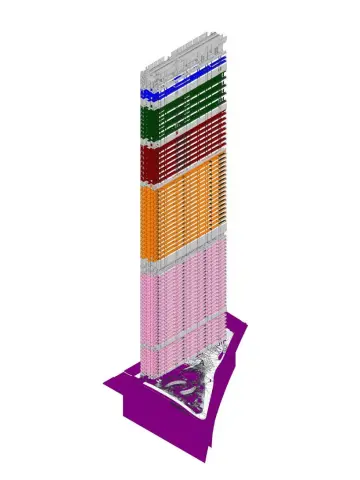 Muraba Veil Tower stands out as the world’s slenderest building. Located in Dubai, it was designed by the renowned Spanish firm RCR Arquitectes, awarded the Pritzker Architecture Prize in 2017.
The project is set on a triangular plot overlooking Safa Park, near the iconic Burj Khalifa, a defining landmark of both Dubai city and the emirate. The hypotenuse of the site follows the canal’s path, while Muraba Veil rises along the side perpendicular to Sheikh Zayed Road.
The tower rises 380 meters over 73 floors, with a length of 100 meters and a depth of 22.5 meters. While primarily residential, it also features a restaurant, a cinema, and dedicated service floors. At its base, a public-access community space has been designed, integrating amenities such as a spa, gym, café, parking, and other services across six underground levels.
This building is a benchmark in innovation and sustainability. Its concrete structure is designed to optimize permeability, generate shade, create thermal gradients, and crosscutting connections around four vertical cores.
Interior spaces are set behind transitional galleries functioning as elevated gardens, enhancing cooling. The façade, made of a porous stainless-steel mesh, facilitates cross-ventilation and naturally reduces temperatures. A standout feature is its podium, with a design inspired by eroded caves, using skylight openings to illuminate the spa in that area.
Modelical’s Services
Modelical contributed to the detailed design phase with the following tasks:
- BIM Architectural Model Management
Supervision and modelling in accordance with RCR’s guidelines. - Technical Documentation Production
Development of plans, sections, carpentry schedules, and other documentation. - BIM Coding and Coordination
Representing our client in BIM meetings involving various project teams.
The project spanned 11 months, involving simultaneous tasks of definition, coordination, and modelling. The core team consisted of two members. During key milestones, the team expanded to five members.
Technical Challenges
1. Model Organization
- Challenge: The building’s mixed-use nature and the repetition of four floor typologies at height created complexity in BIM model management.
- Solution: The project was made up of linked models based on use and typology, optimizing the repetition of common elements. Three main models (above ground, underground, and façade) were developed, along with five auxiliary geometry models and a central documentation model for extracting plans and schedules.
2. Rhino to Revit Interoperability:
- Challenge: The podium was designed as an organic cave-like space, modeled in Rhino by the architects without parametric rationalization, resembling a hand-carved sculpture. The key challenge was translating this design into Revit while ensuring usability for engineers.
- Solution:
- First, geometry types were categorized based on their function (structural, architectural, furniture, etc.) and form (flat, curved, double curvature, mesh, subdivision surfaces …).
- Secondly, the most efficient method for importing geometry into Revit was analyzed—whether through masses, direct shapes, families, or direct modeling via Rhino Inside, with the latter being the main approach.
- We define efficiency in the transfer as: fewer operations, shorter processing time, reduced Revit model weight, reliability with the original geometry, and better projection visualization in Revit. In some cases, the chosen option was not the most true to the geometry due to incompatibility with the other criteria.
- Different workflows were established for each method, and efforts were made to standardize them as much as possible to simplify operations, reduce processing time, and enable multiple coordination iterations.
3. Clear Graphic Documentation:
- Challenge: Generating documentation that clearly conveyed the complex spaces of the organic design while using geometry imported from Rhino.
- Solution: The import process was planned with this in mind, ensuring most geometries were resolved at that stage. For complex geometries that Revit could not process effectively, a combination of Rhino-generated CAD sections and Revit sections was used.
Key Technical Outcomes
- Project structure: 8 primary models + 1 documentation model.
- Interoperability: Combined use of Revit and Rhino via Rhino Inside.
- Clash detection: 324 Navisworks tests resolved.
- Issue management: 616 open issues handled in ACC.
- Families created: 400 new families developed based on RCR’s designs.
- Generated plans: 111 technical drawings produced.
- Complex geometry transfers: Over 15 Rhino-to-Revit geometry transfers.
- Weekly deliverables: Regular exports of PDFs, DWGs, and NWCs.
- Efficient communication: Client communication managed via Slack and structured information custody.
Gallery


