

Civil projects and BIM Methodology
Part I: Context and challenges
1. Context
In 2019, Spanish agencies such as ADIF and AENA have awarded contracts to implement the BIM methodology in their business areas. The amount of these implementation processes exceeds 4 million euros.
BIM methodology originated in the building environment. Applying the methodology to civil works raises the following questions.
Do engineering companies have enough BIM knowledge to lead the project strategy?
Some may say that it is the end customer who must possess this knowledge, since it is the one who leads the development of this type of project.
The reader should be reminded of the above paragraphs, which explain that agencies such as ADIF are making a significant effort (more than three million euros in this case) to incorporate the BIM methodology into their business.
Once developers are already acquiring knowledge, it is clear that engineering companies have the need and responsibility to acquire this strategic knowledge.
/p>
Some may also say that, since the BIM methodology has its origin in the field of building, its application in the field of civil engineering does not make sense. The reader is only a few paragraphs away to check that there are regulations that explicitly include the application of the BIM methodology to civil works.
Some strategic knowledge is required to overcome the challenges that arise in the application of the BIM methodology in linear work projects.
2. Challenges
2.1 Do we know the rules?
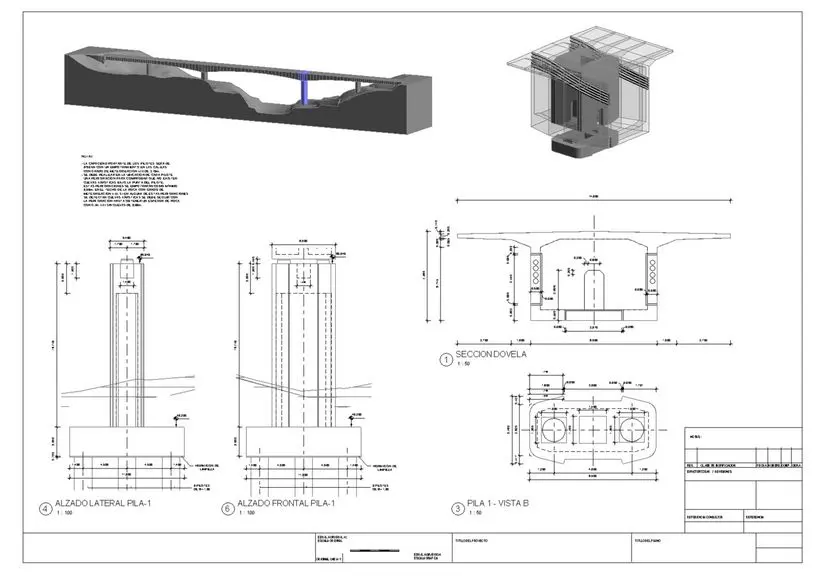
The BIM methodology must be applied according to the ISO 19650 standard: “Organization and digitization of information about buildings and civil engineering works, including building information modelling (BIM)”. The title already indicates that it is a standard dedicated to both the building and civil engineering fields.
On the other hand, this regulation includes the principles that should guide the implementation of projects under BIM methodology. It is essential that the agents involved in the development of a project know these principles, and this includes the engineers.
2.2 What should be modelled in a civil works project?
Engineers will face unspecific tendering processes related to BIM. How can they overcome that?
The scope of a BIM project is defined, from greater to lesser importance, by the following factors:
In case the developer requests BIM methodology without defining the previous points, the engineer should clarify it before submitting an offer.
As an example, given the project of a tunnel, the following cases may happen when working under BIM methodology:
The implications in effort and time for each of the three previous cases can lead to the failure of the project. This is the importance of clarifying what must be done before making an economic estimate of the costs of a BIM project.
2.3 How much more will it cost?
Knowing scope of work and the work strategy, we can apply performance ratios to forecast the workload.
Pilot projects may be used to quantify these performance ratios. Critical aspects are:
Making good use of current coordination and collaboration platforms, and establishing workflows aligned with the BIM methodology can help limit the cost of a project.
Using systems that are not aligned with the BIM methodology will undoubtedly make the project more expensive.
Thus, the cost of a project is influenced both by the modeling performances and by the collaborative, coordination and communication processes.
2.4 Civil design software to BIM software?
Buildings are modeled against reference systems of grids and levels. In the civil environment projects, the reference is the corridor axis.
Working in this environment is not impossible, any strategy will be valid as long as it generates consistent information and allows the application of changes in an agile and reliable way.
The gap between Civil design software and BIM is filled by the use of programming tools inside the modeling environment.
Useful information exchange formats in this field are:
The programming tools (both script and visual) allow BIM elements to be placed along the corridor and site.
2.5 Overcoming the extension limitations of BIM models.
Some BIM software, such as Revit, has limited geographical extension. However, projects of greater length than the editing scope limitations have been successfully modelled under the BIM methodology. This is achieved with an appropriate subdivision of the models and the use of shared coordinates for the correct location of each model part.
Local models generated by the editing tools can be integrated and coordinated in the coordination tools, since the latter do not have extension limitations.
2.6 What elements need to be modeled with BIM?
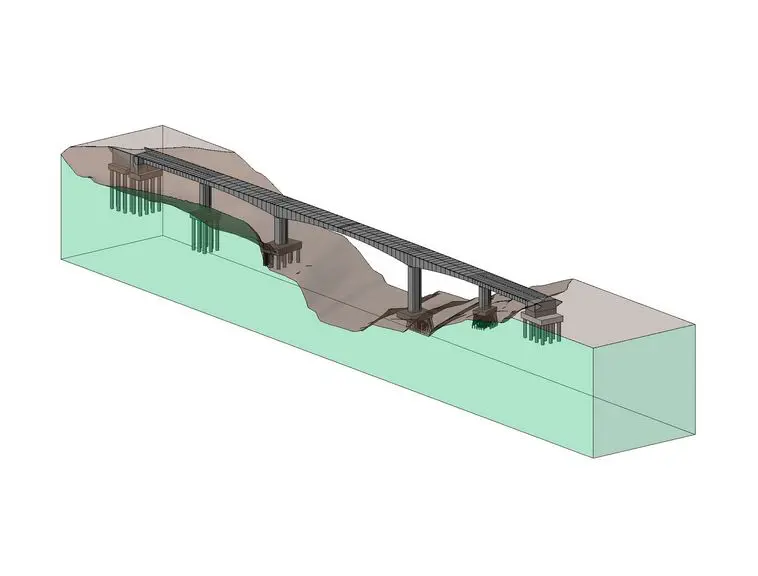
Any element of a civil construction project can be modeled with the BIM methodology.
Using common BIM edition software we can create every element that was represented with CAD technology.
However, elements to be included in the model depend on the required BIM uses. It is possible to model elements such as:
2.7 Customer satisfaction and efficiency balance
It is possible that the project developer requirements are not aligned to information consistency and process efficiency.
Proactivity from the engineer requires mastery of the BIM methodology. The first step is to understand that the BIM methodology has its own regulations (ISO 19650) aimed at efficiency.
This is illustrated below with three examples:
The generation of three-dimensional models and their transmission through devices like CDs or flash memories is not only inefficient, but against the BIM Protocol. This document tells the client to deliver the information through a Common Data Environment (CDE). Thus, a developer must enable an information exchange platform.
Inserting CAD drawings into and BIM Models is against the principle of a single source of consistent information promoted by the BIM methodology.
Over detailing BIM models is as well against model efficiency, and not recommended. Callouts and detail items must be used for that purpose.
In short, decisions that do not take advantage of the current BIM collaboration, coordination and communication tools or promote processes that are not easily automated are not aligned with the BIM methodology.
2.8 I’ve already modeled. What about the drawings?
As a rule of thumb, drafting takes the same amount of time as modelling.
For example: If one month is required to produce the 3D model, the team will require another month to produce the 2D drawings from the model.
As a conclusion to that, automation can be applied not only at modelling but also at drafting. Automated section views creation along the axis is an example of that.
Last but not least, some applications just can not deal with the amount of data of civil projects. In that case, simplification and programming may help.
Authors: Oriol Vidal, Francisco Tabanera and Javier Giménez.