

Wooden roofing
Part I. Alfarjes: parametric modeling
Timber roofs
Introduction
Modeling digital twins for the built environment is a rather common practice these days. It delights us to recognise that, in many cases, these models also include artistic elements. The modeling of these elements brings challenges in terms of efficiency and reasonability in the level of detail.
In this post, we will take you through the modeling of a timber roof with detailed woodwork being respectful with its structural and constructive behaviour and reaching an appropriate level of detail to express its artistic value.
Part I: Alfarjes
Definition
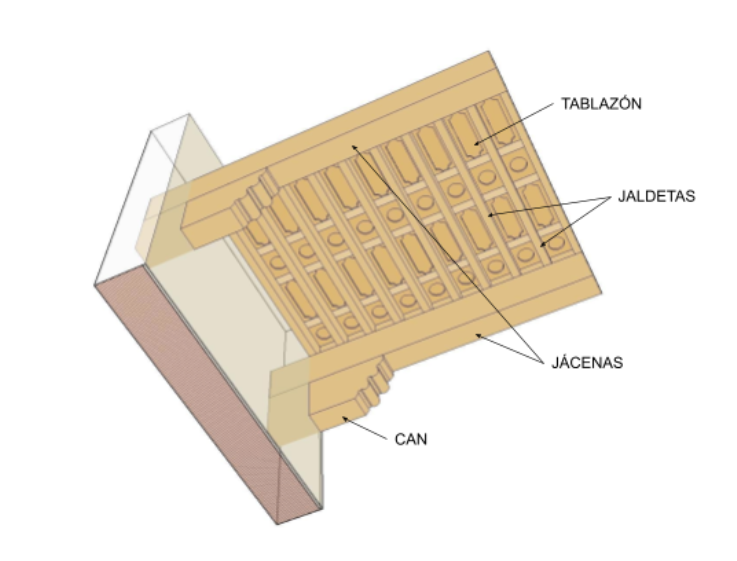
The ‘alfarje’ is a detailed woodwork ceiling composed of carved and entwined timber planks with its origin in Andalusian culture. It consists of beams and mouldings. The master beams are unidirectional and they can be either embedded or supported on corbels (can) on both sides. On top of these beams, and in the opposite direction, we find smaller beams called mouldings. Both structural systems are covered by a number of wood panels called ‘tablazón’.
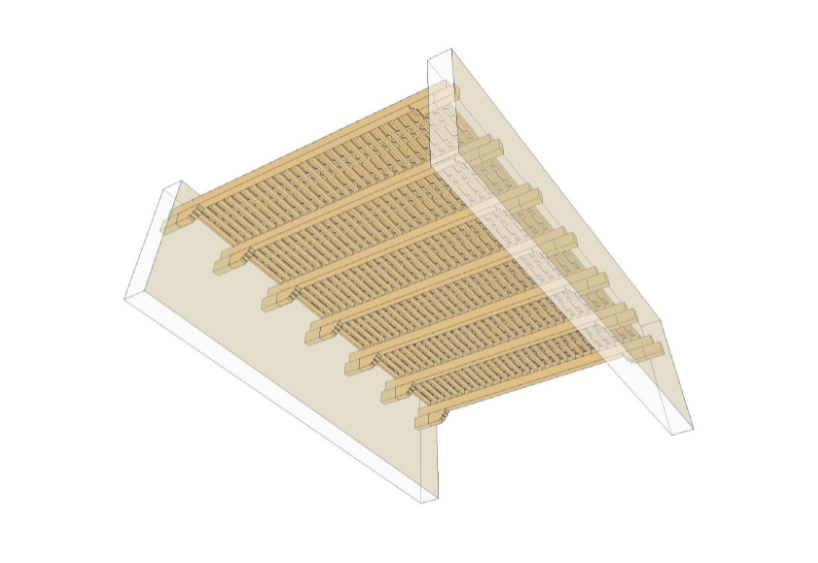
Modeling and parametrization
To make it more understandable, we are going to detail each one of the elements followed by the modeling proposal:
Jácenas (master beams):
As mentioned before, the master beams are unidirectional. Usually the most important beams in a structure are represented in Revit using the "Structural Framing Beam" family. This is because this family contains geometrical properties that allow greater freedom in their placement (differences in support heights, rotation, variable spacing, etc.). It also contains properties of the analytical model which could facilitate the structural study of the woodwork ceiling.
Jaldetas (small beams):
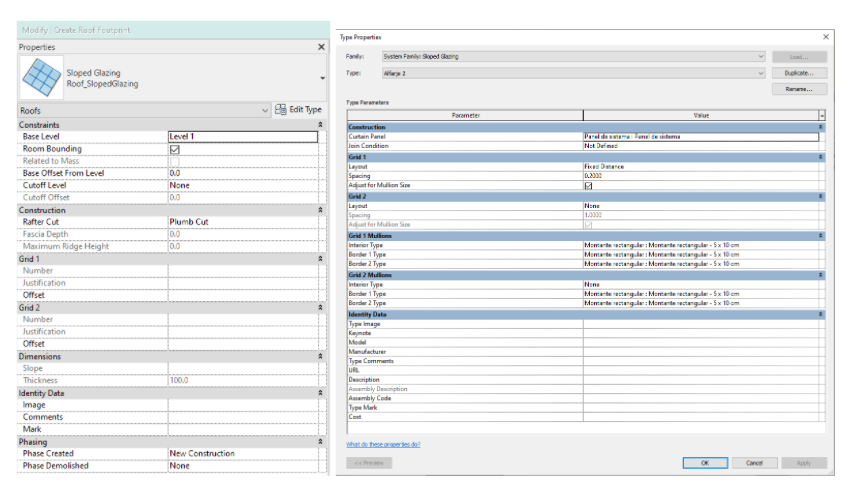
They are a type of smaller beams which is arranged transversally to the master beams. These elements are similar to what are known today as joists (¿viguetas?), and have been modelled in Revit as a "Structural Beam System". However, the "Sloped Glazing Roof System" tool is more useful because it allows maintaining the same geometrical restrictions of the beams (maximum spacing, maximum number of grids, etc.) being modelled as mullions and in addition the creation of the slab.
Tablazón (slab):
Traditionally in the “alfarjes”, the whole construction element is covered by slab. This slab covers the spaces between the beams with wooden planks, tiles or as for bricks. For its modelling, it is proposed to use the "Sloped Glazing Roof" as it allows for the addition of an automatic interior panelling that is easily configurable, editable and quantifiable.
Can (bracket):
It’s an element that is placed under the master beams, in the form of a bracket to reduce its span and support it. These can be modelled in several ways, but we consider that one of the most interesting means is to generate them from a Generic Model face based. In this way, they can have a wall face host on which they are embedded and regulate this embedding with a parameter.
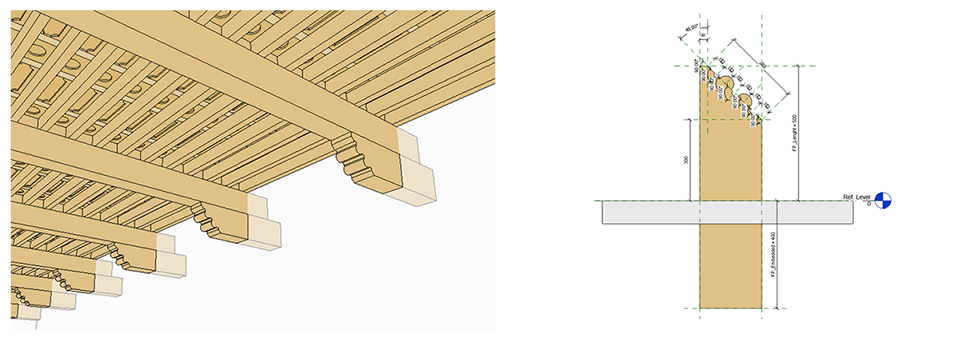
Other solutions could be combining the beam system and the roof, ceiling or floor tools. However, this way of modelling comes with some problems in quantifying the components of the woodwork ceiling and is also more time-consuming when modelling the slab.
Modelling solutions summary
Modelling | Pros | Cons |
Beams + Sloped Glazing Roof + | Automatic paneling Increased possibilities for components parameterisation Easier measurements extraction | No analytical properties are contained in the small beams |
Beams + Structural Framing Beam + Roof/Ceiling/Floor ++ | Master beams and small beams contain analytical properties for their structural study Allows to create a 3D beam system (non-coplanar) | Involves creating sketches for the slab Separate sketches for each type of roof/ceiling/floor Slab is not adaptive (manual modifications) |



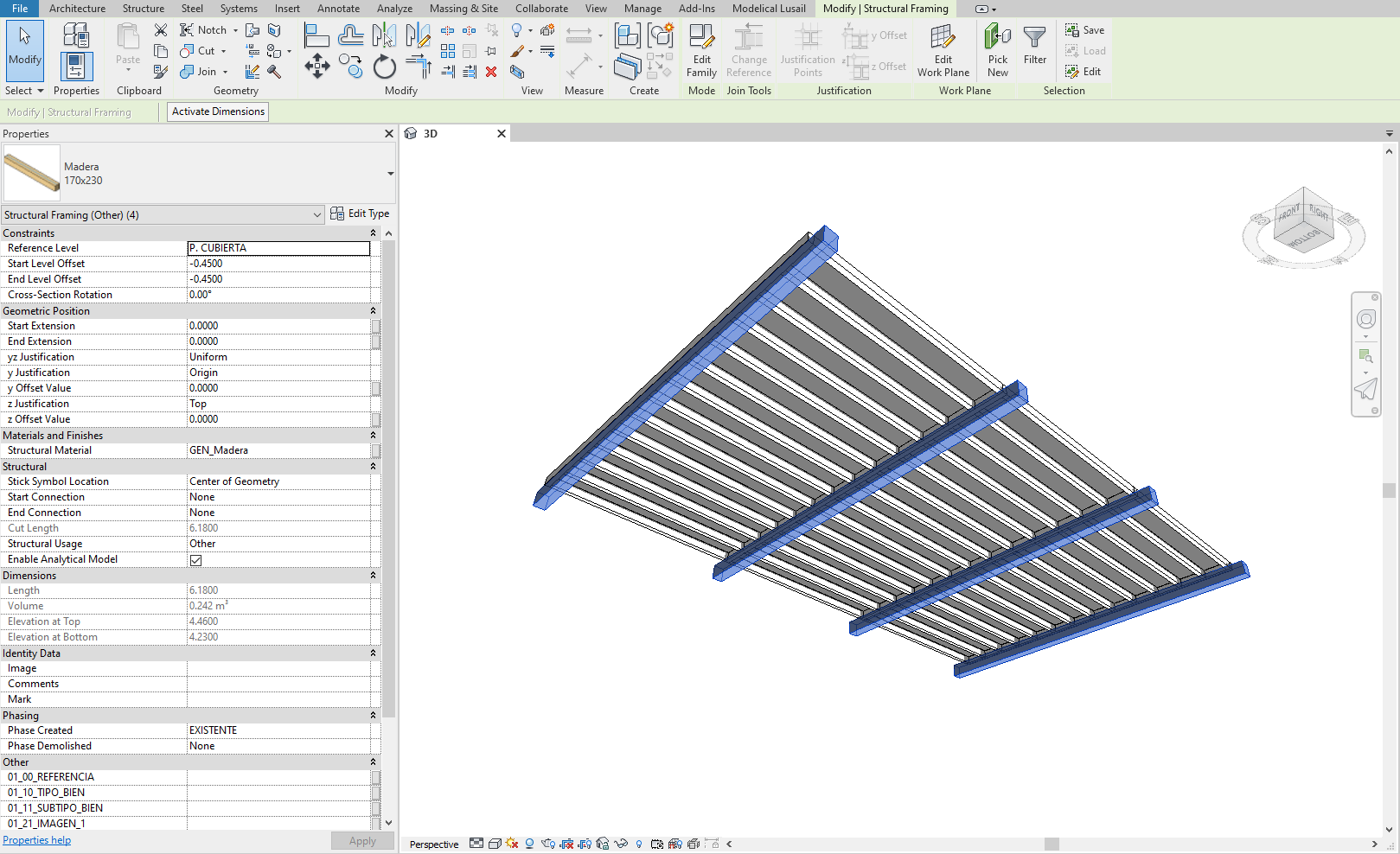
Master beams modelled by beams
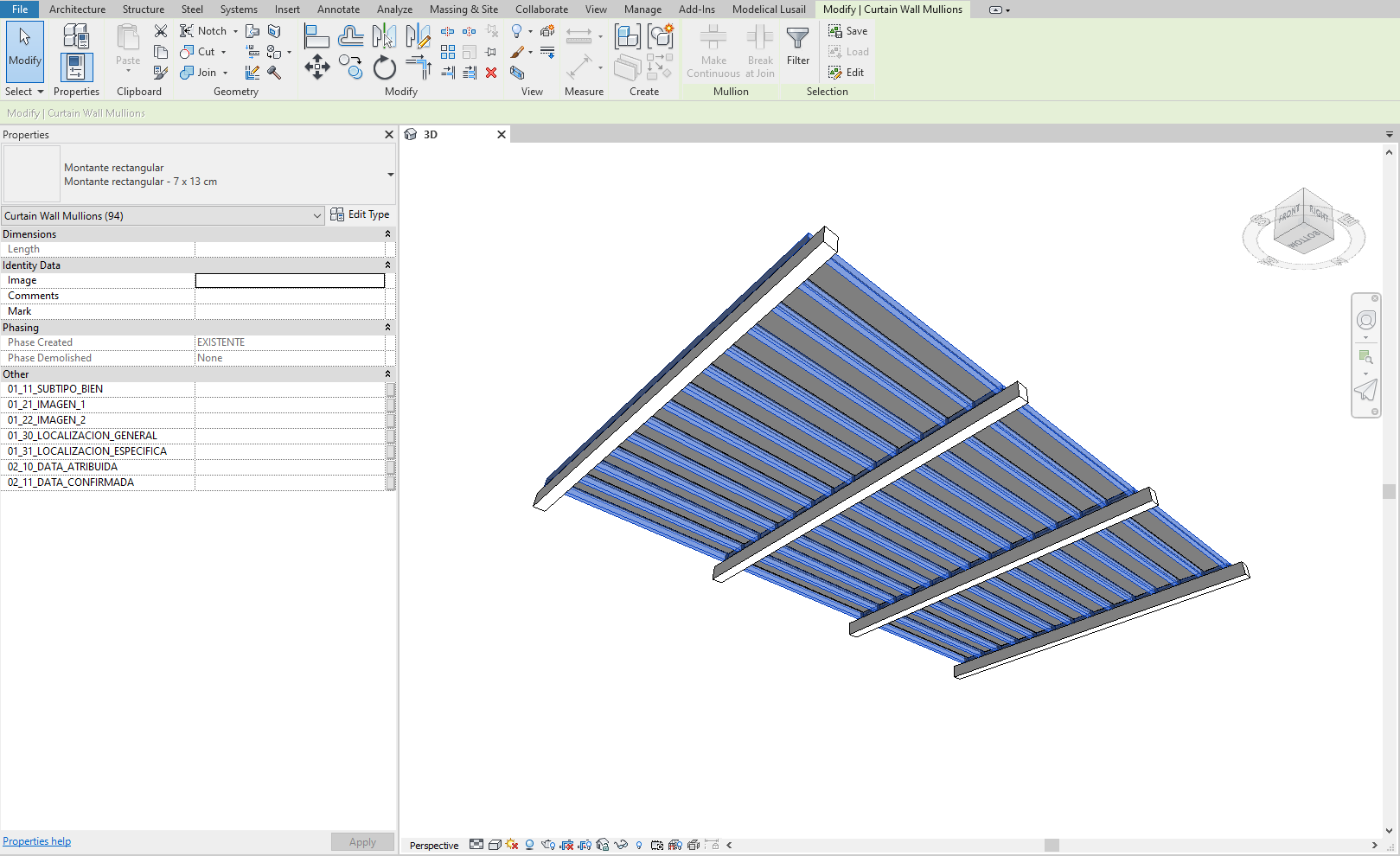
Small beams modelled by sloped glazing roof mullions
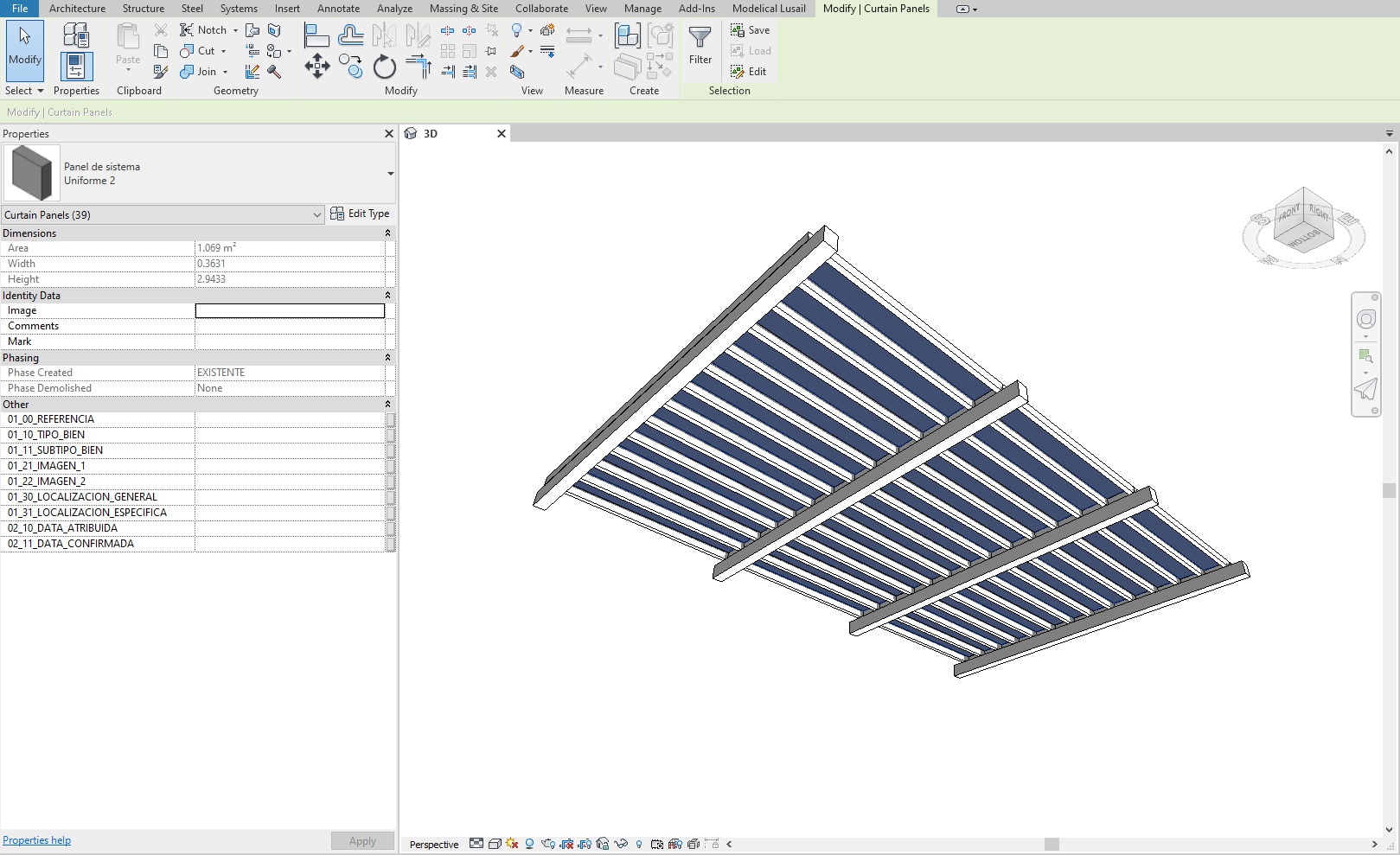
Slab modelled by sloped glazing roof panels
Elements measurement
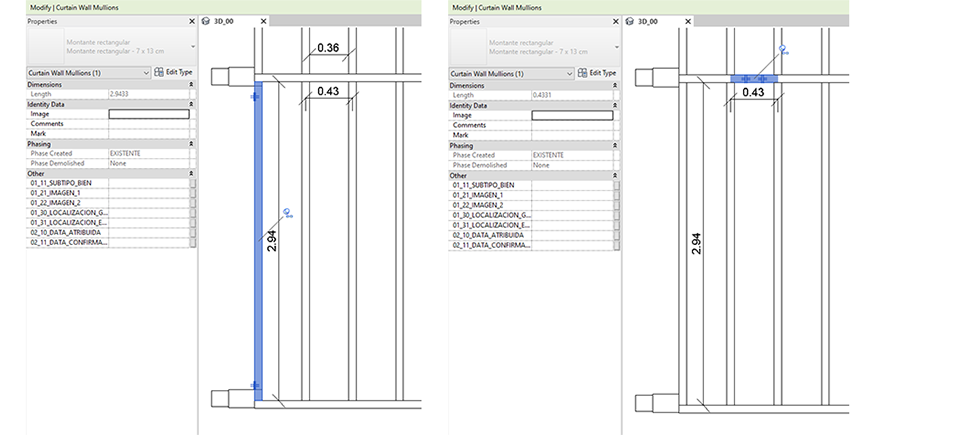
If one of the main objectives of the model is the measurement and quantification of all the woodwork ceiling elements, we have to use the panels themselves instead of the extruded curtain wall profiles. This is due to the behaviour of the mullions when they are delimited by a transverse grid. Depending on the layout of the grid, some elements are automatically modelled correctly by the program. That is, the length of the geometric modelling matches with the length parameter dimensions. Nevertheless, in horizontal mullions, this dimension does not match because several elements are modelled individually following the restrictions imposed by the grid.
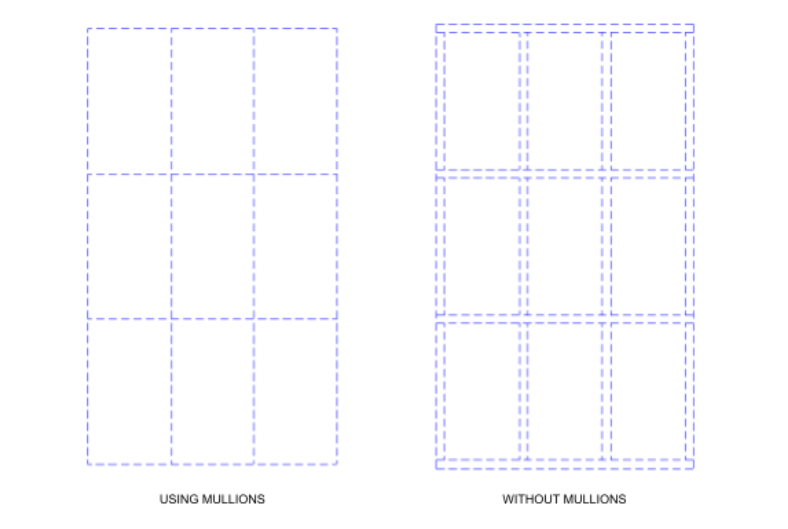
Therefore, some of the elements are not measurable using this panels and mullions system, and it obeys us to use the grids as panel separators and not as hosts for the mullions. In this way, both the beams and the slab are considered as panels when modelled.
When the slab is constructed using traditional techniques that incorporate more ornamentation to the elements between the joists (e.g. "cinta y saetino"), the panelled roof system is even more useful, as we can increase the number of divisions by adding transverse grids.
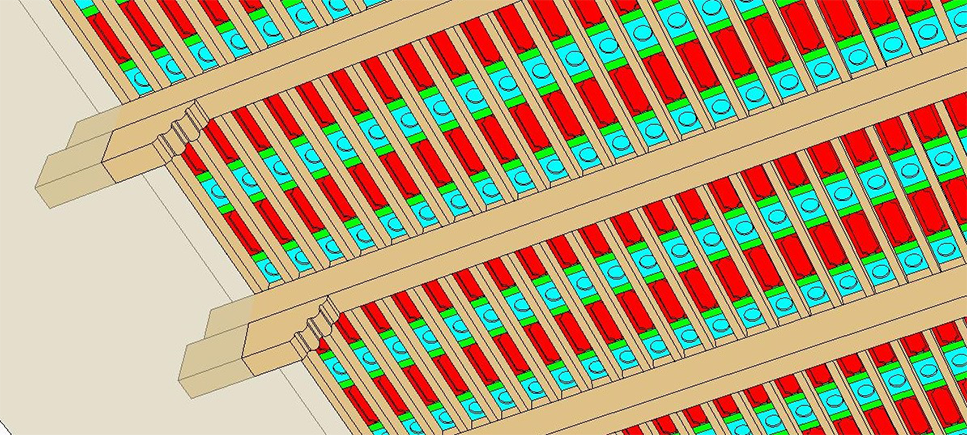
Each of these small panels, into which the panel is divided, are modelled through the "Curtain Panel" family. In such manner, we can load different types of panels that we have modelled into our project, and by selecting the system panels, we can replace them according to the design of the element. All of them being measurable and quantifiable.
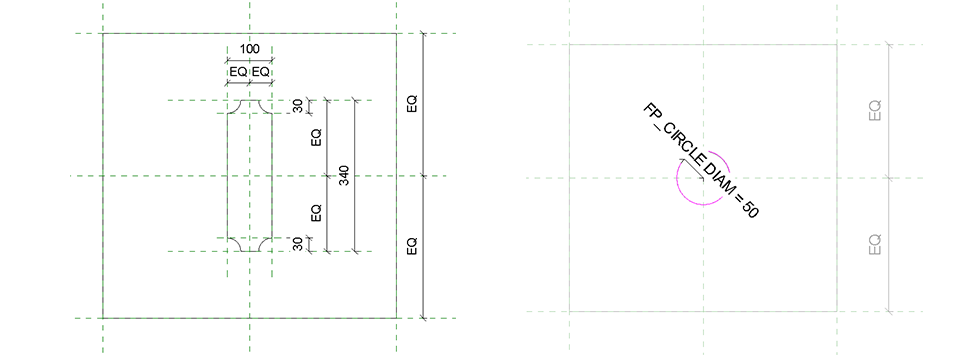
Parametric panels with simple shapes
Tips & Tricks
- "Model as-built": start by positioning the master and small beams correctly. Then model the basic panelled roof (without defined mullion profiles) on them.
- Establish rules or constraints for the elements. Subdividing the roof before modelling. Answer questions such as: Is there a variable or constant spacing between joists?; Is it a simple or complex (>1 interior element) slab?; Are the mullions or transoms continuous at the joints?
- Avoid restrictions in the sketch of the roof.
- Parameterise the panels with shared parameters so that they can appear in quantification tables.
In part II of this publication, dedicated to the modelling of wooden roofs, we will tell you how to solve a coffered ceiling using parametric panels.