

BIM Templates for Logistics Centers
The Key to Streamlined and Scalable Expansion
The rise of e-commerce and the increasing need to optimize supply chains have driven the development of more efficient, sustainable, and technologically advanced logistics centers. In this landscape, Building Information Modeling (BIM) has emerged as a key tool for tackling the challenges of designing, constructing, and operating these facilities.
BIM goes beyond 3D modeling by offering a collaborative environment that centralizes all relevant project information. When applied to logistics centers, it enables the efficient integration of layout design, building systems, and the flow of goods and people within a single, coordinated digital model.
The Power of BIM Templates for Logistics Centers
One of the key concepts in implementing BIM for logistics centers is the use of templates. These templates serve as standardized models that consolidate best practices, essential data, and predefined configurations, allowing new projects to be launched quickly. The benefits of using BIM templates include:
Consistency and Quality
BIM templates ensure that all projects start from a solid and unified foundation, avoiding information inconsistencies and promoting high standards of quality across every stage of design and execution.
Thanks to a standardized design that typically covers around 70% of common requirements, replicating projects across multiple locations becomes more efficient, processes are streamlined, and the margin for error is reduced.
Cross-Project Standardization
For organizations operating across several countries or regions, template standardization allows designs to be replicated easily and supports regional supplier selection, optimizing both time and cost.
Even when local regulations or project-specific needs introduce variations, the BIM template ensures that no project starts from scratch. Only the necessary elements are adjusted, while the overall structure and original parameters are largely preserved.
Built-In Continuous Improvement
Working with a template also initiates a process of continuous improvement through iteration. The template is designed, put into use, refined based on lessons learned during on-site construction, and then readjusted. From one project to the next, the template improves and delivers greater accuracy in both design and cost estimation.
Time Savings
By reusing proven configurations and processes, the initial design phase is accelerated and delivery times are reduced. Starting a logistics center project from scratch, developing it, and coordinating it requires a significant portion of the total design time.
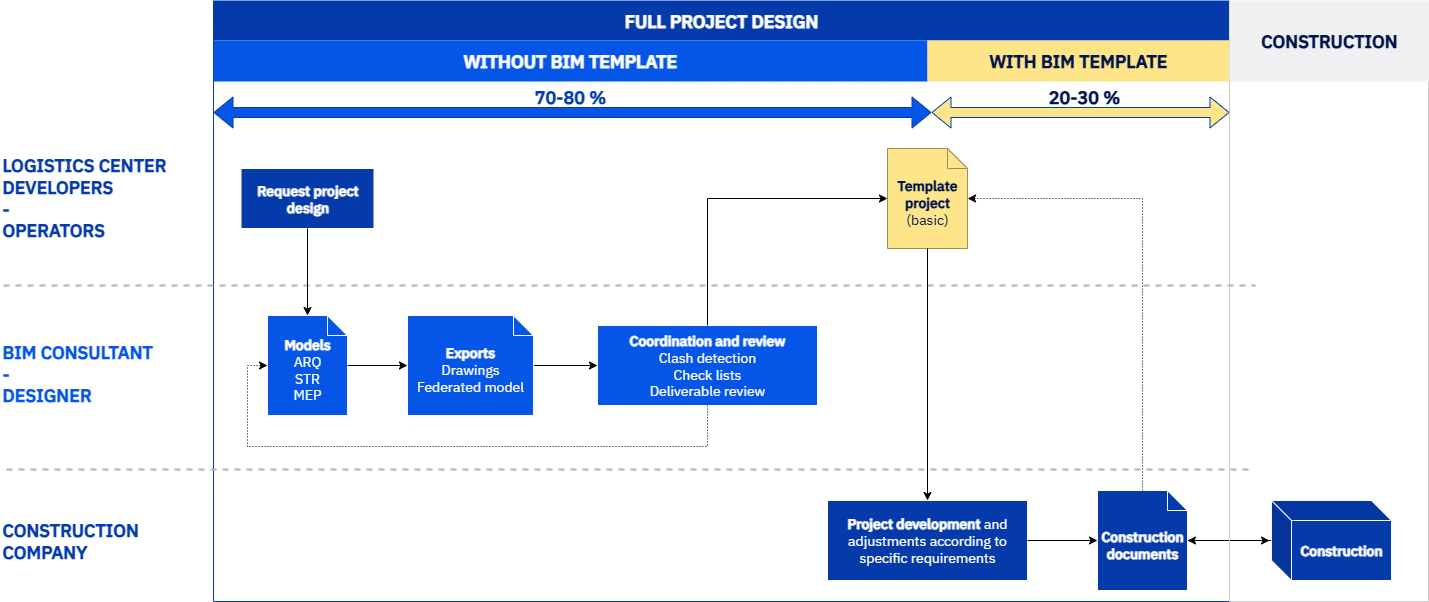
A logistics platform project developed in BIM typically involves:
- Modelling various disciplines such as architecture, structure, and building systems
- Coordinating these disciplines through clash detection
- Producing the required documentation
- Delivering and reviewing all outputs
In fact, logistics facilities are a type of building that rarely differ from one another, especially when they belong to the same operator. These buildings tend to follow a standard structure, and their internal layout is usually clearly defined due to the normalization and automation of their processes.
By starting from a template project where all these steps are already configured, logistics companies can save a significant amount of time when creating projects that are very similar to each other.
In practice, a BIM template is a project in itself. It includes all the standard components: configured models with loaded families, parameterization, naming conventions, and standards defined in accordance with the BEP, among others. This ensures a final model that is fully coordinated and aligned with the needs of the project.
This time savings not only accelerates development, but also allows more effort to be invested in the final design, resulting in a more refined “product” and reducing the number of suboptimal decisions during later construction stages. These decisions, when made on site, often lead to greater complexity and higher costs.
Furthermore, the impact of a BIM template on real estate decision-making cannot be overlooked. Having a ready-to-use BIM template not only simplifies the launch of a new project, but also enables early site-fit studies and a more effective assessment of investment viability.
Baseline for Budget and Carbon Footprint
One of the biggest challenges when launching a project is accurately estimating both its cost and its environmental impact—particularly in terms of carbon footprint. A BIM template can serve as a baseline that allows multiple key project dimensions to be monitored, including these two, but not limited to them.
Cost Estimation
A coordinated design template linked to a pricing database enables reliable cost estimation for materials, labor, and equipment. For example, a predefined cost baseline makes it easier to anticipate budgets for regional or even national expansion plans. This baseline can also be easily adjusted as project variables change, such as design modifications, site locations, or supplier options.
Carbon Footprint
BIM makes it easier to store and analyze detailed data, such as the types and quantities of materials, their origin (local or not), and the associated logistics, such as transport. With this information, it is possible to calculate the project’s carbon footprint and optimize the design to minimize its environmental impact. This is not only useful for evaluating the project’s sustainability, but also for streamlining environmental certification processes, such as obtaining LEED or BREEAM ratings.
As mentioned earlier, BIM templates offer additional use cases, such as forecasting a building’s energy performance, estimating schedules based on parameters and construction sequences, or planning future maintenance—optimizing both cost and operational management. Ultimately, a BIM template makes it possible to monitor the project’s most critical aspects, supporting more informed decision-making throughout its lifecycle.
Conclusion
Implementing BIM in logistics centers not only improves efficiency in design and construction, but also ensures optimal management throughout the entire lifecycle of the building. BIM templates, in particular, are a powerful tool for standardizing processes, reducing timelines, and ensuring quality in complex projects.
BIM has become an indispensable resource in the logistics sector, where speed, precision, and sustainability are critical factors.