

Digitization and Assets Management
Using BIM for FM
Much has been said about the benefits of the BIM for the Facility Management phase but it has not been explained how these are made effective. In this article we present the use of intermediate platforms to configure BIM and FM integration.
Converging paths
Facility Management and BIM methodology are meant to go hand in hand. They have experienced a similar boom in recent years: while BIM was gradually gaining ground in projects and construction works, Facility Management was claiming its place in the global consciousness of organizations.
Facility Management claims, with all the sense, its application not only at the end, when the project is already built, but in the first phases of its conception, linking with the idea of the building lifecycle to which BIM is intrinsically associated.
In the following image shows a scheme of that lifecycle. The operations associated with its different phases have been broken down into 3 points of view: one from the owner (Asset), one from the designer (Project) and one from the Asset Manager (Facilities Management).
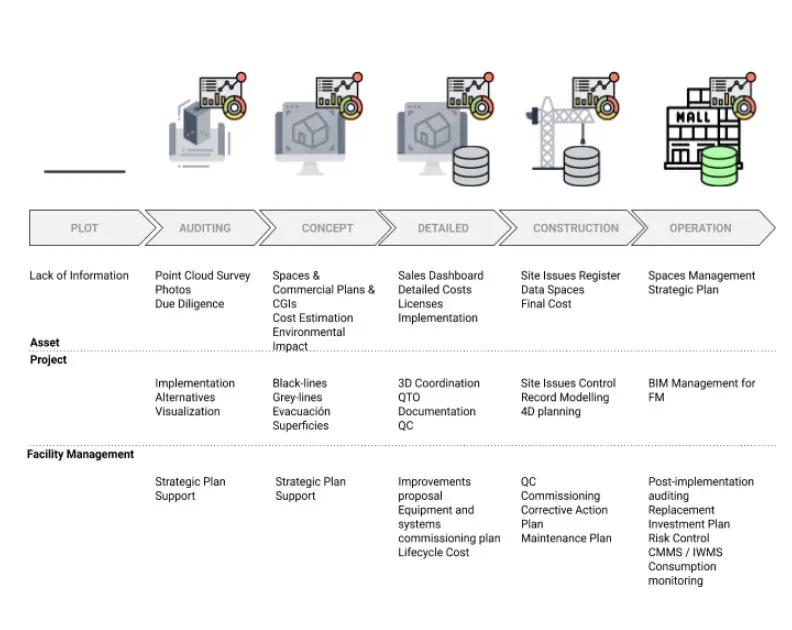
We see in the figure that BIM does not appear as one more vision or as a parallel project, but that BIM is already accepted as a methodology applied in the whole process: the digital models are already an asset.
Is it possible that in the future, asset management will assume these terms? That a real estate asset is composed of a physical part and its digital twin? Owners, builders and designers are already aware of this possible new scenario, but… what about Facilities Managers?
We are not going to stop and explain why the Facility Manager will do much better using BIM. We are sure that they might wonder : Well, I believe this BIM thing, but how do I do it? Where do I look at the model? How do I extract its data?”. We are not going to talk about why they should use BIM but how should they use it.
It can be argued that “there are already CMMS or IWMS that integrate BIM”. Yes, we know that there are already very advanced programs with BIM integrated. Other simpler ones are in process, but in most cases, those programs will not cover the whole range of needs and/or possibilities of using BIM in FM.
In other words, the integration “button” does not exist: if there was no single solution for FM before, there will not be one for BIM and FM now either. The BIM-FM integration must be designed for each specific case and will be done according to the characteristics of each asset, the agents involved, their relationship model with the Facilities Manager, their services contracting model and will surely involve more than one digital platform.
BIM and FM integration, but how?
BIM models are a tool, and FMs have their tools too, at worst an excel, at best, dedicated programs. Both tools share something fundamental: asset information. From here we can start asking questions.
How can the information be passed from the BIM models to the CMMS, to the service contracts, to the Maintenance Plan, to the Investment Plan,…?
Is that a one-way, one-time step?
What happens if the model changes?
Who changes the model if the physical asset has changed?
The following figures attempt to illustrate these relationships.
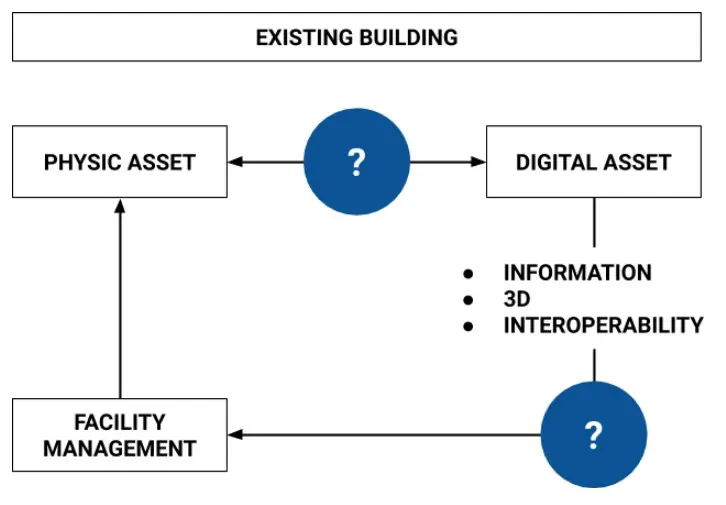
How and where is the digital asset updated, and who does it?
How and where is BIM used in Facility Management and who makes it possible?
In the case of a developing project, we are left with only the second question, the one that questions how the FM will take advantage of the BIM at its disposal.
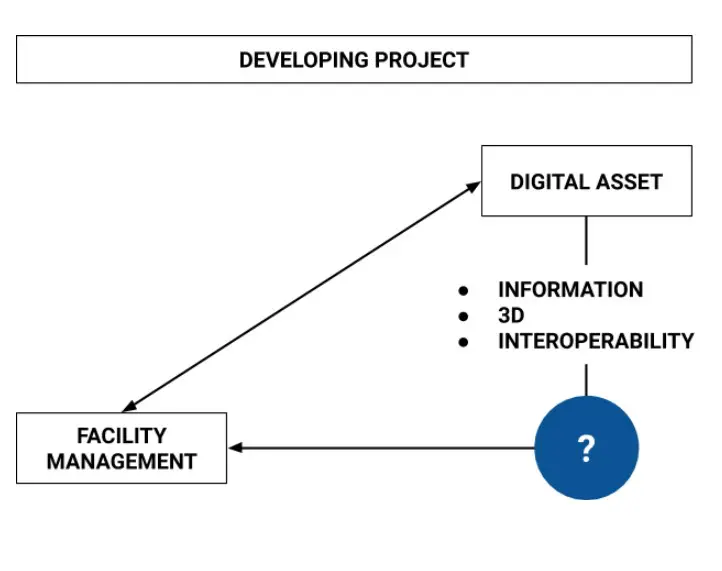
We believe that this problem has two sides, the technical and the cultural. And we know that it is more difficult to beat the cultural one.
Let’s start with the cultural one: BIM experts are necessary to make the previous charts work. Suddenly a new need, a new team, or a new management arises: it implies an added cost to the traditional scheme. The better management derived from the BIM and the FM will mean savings in terms of time and money, but that must be clear for the property to make the consequent new investment. That is for the property, but the FM has a new player in the game and must also know how to fit it.
Facility Managers who know BIM or who have a BIM partner will have a clear advantage over those who do not. This advantage will be reflected not only at the level of getting the contract or securing it, but at the level of using the models themselves to optimize and improve their tasks.
As per the technical problem, digital models are created and edited on dedicated platforms that require specialists who are continuously trained in the field. These platforms should not be the FM workplace. The Facility Management must consult the models, not edit them.
We got to the point where we explain what the trend will be in terms of BIM and FM integration.
We are convinced that the solution will be an intermediate platform that shows the BIM models (information and 3D) in a way that can be used by FM, either via CMMS or another application. In the following figure we try to explain this:
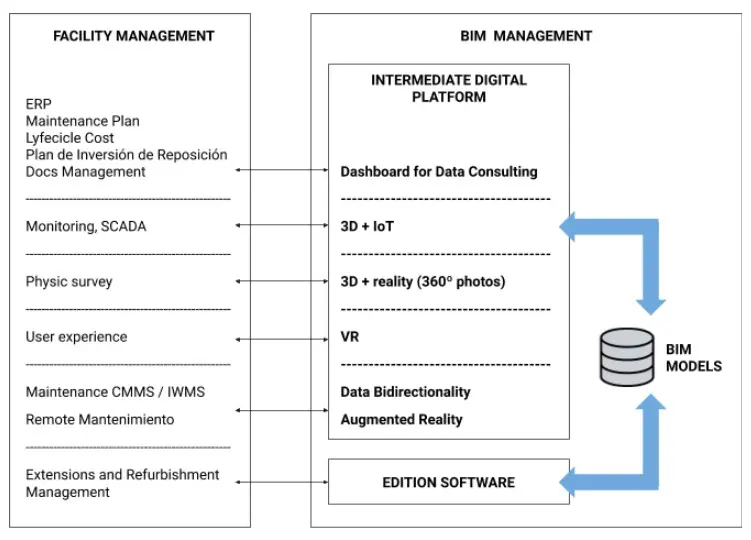
As shown in the figure, each FM requirement corresponds to a data query from the models. This query takes a different format depending on the data to be extracted.
The graph shows how the use of the models has been added from the editing programs themselves (Revit, AECOsim, etc) for refurbishment projects or for model updates with respect to changes that have already occurred in reality.
Conclusions: Information Maintenance.
For all this to make sense one thing must be fulfilled: the BIM models must be updated and they must reflect the reality of the real estate asset. Otherwise we will return to the feeling of unreliability in the control of the information provided by the traditional system.
This Information Maintenance must be included in the long list of services to be managed by the FM, because it is one more service to the organization, and one of the important ones since knowing what I have and in which status, is the first starting point before any decision.
Authors: Almudena Gómez and Alberto Ramos.
Para activos físicos no conectados,
Extensión a mantenimiento plantas industriales ¿lo veis posible?.
En Mantenimiento los sistemas informáticos se denominan CMMS Computarized Maintenance Management Systems. Son típicos Máximo y SAP (hay muchos otros).
Se discute ahora integración de visión avanzada remota (o mixta).
Hola Antonio,
Gracias por tu comentario. Se pueden hacer modelos BIM de plantas industriales y su proceso, deberían definirse muy bien los objetivos de los modelos para acertar con su desarrollo. En cuanto a la visión en remoto es algo de lo que cada vez se habla más, aunque en mi opinión hay que ir paso a paso. Saludos,
Hola,
Me pongo a pensar en la vida útil de un activo y me preocupo:
Una de las pegas que veo al modelo que propones es la perennidad del formato nativo del software de modelado, que va cambiando de versión en versión y lleva consigo pérdidas potenciales de información e incompatibilidades en el software específico desarrollado para la conexión con el GMAO. También es un riesgo para un gestor de FM depender de una empresa externa que puede desaparecer a largo plazo. En mi opinión el gestor FM debe de exigir un modelo BIM en formato abierto (ojo, que también evoluciona) y pedir a los modeladores que sean capaz de añadir/eliminar elementos de este modelo manteniendo siempre un formato establecido de metadatos asociados a los elementos que se añaden/modifiquen.
Pues no sé qué pensará Almudena. Yo estoy de acuerdo contigo Juan Antonio, pero no glorifiquemos el IFC, con los estándares abiertos a día de hoy se pierde mucha funcionalidad. Creo que hay que pedir las dos cosas.
Gracias por tu comentario Juan Antonio, creo que lo que comentas entra dentro de la concepción del Mantenimiento de la Información del último párrafo. Cualquier solución efectiva pasará por la vigilancia de su actualización ya sea en contenido o en formato.