

Parameter’s life cycle in BIM models
We all agree that BIM models are containers of structured information. We also agree that a model can evolve over time in the same way that a project moves from design phase to construction and then onto its life use. This topic becomes more complicated when defining the parameters that will house that information and when defining how they will adapt to the evolution of the model.
In principle this should be solved with a BEP (BIM Execution Plan) or with appropriate EIRs (Employer’s Information Requirements), but we are not always in that situation, and even so, there are several doubts that arise regarding this issue. Here are some of the possible ones:
Will the parameters used in the Design phase be the same ones used by the Contractor’s team?
Will the different collaborating teams be using the same parameters for similar information?
Are all the existing parameters in the model valid? Including those that come by default and those that we drag from families that we have not created ourselves? How is it indicated whether they are valid or are not?
What if they come from different software? Or IFC parameters?
What naming criteria is more appropriate for the parameters?
Model reliability and parameter management
One of the key reasons for adopting BIM as a methodology for managing projects and real estate or infrastructure assets is the reliability of information.
The fact that a unique and single source can feed information to all queries at once, regardless of whether the request is a plan, a quantities extraction or a 3D view, allows us to assume that this information will be at least consistent.
The fact that the source is the only place where I can access this information allows us to assume that this information will be the only one possible and that I do not have to look for it in other documents.
But for all this to be valid, among other things, we have to maintain the digital assets (BIM models) and we have to take care of their format and content so that they work well. Furthermore, we have to do this in the Design and Construction phases and above all in the Operation and Maintenance phase.
If during the transition from Design to Construction, parameters are not reviewed and we find information unreferenced, the model will begin to generate distrust.
Once the project has been finalized, if the model has not been updated with the latest renovations or extensions, it will be as unreliable as the multiple versions of AutoCAD drawings that are stored in a traditional project.
For this reason Information Maintenance is something that must be ensured within BIM models..
Parameter’s life cycle
Parameters, their information and the responsibility for them, are intrinsically related to the phase of the project or the moment in the project’s life cycle.
Below is a diagram showing the Information’s objective and responsibility, through the life cycle of the digital assets.
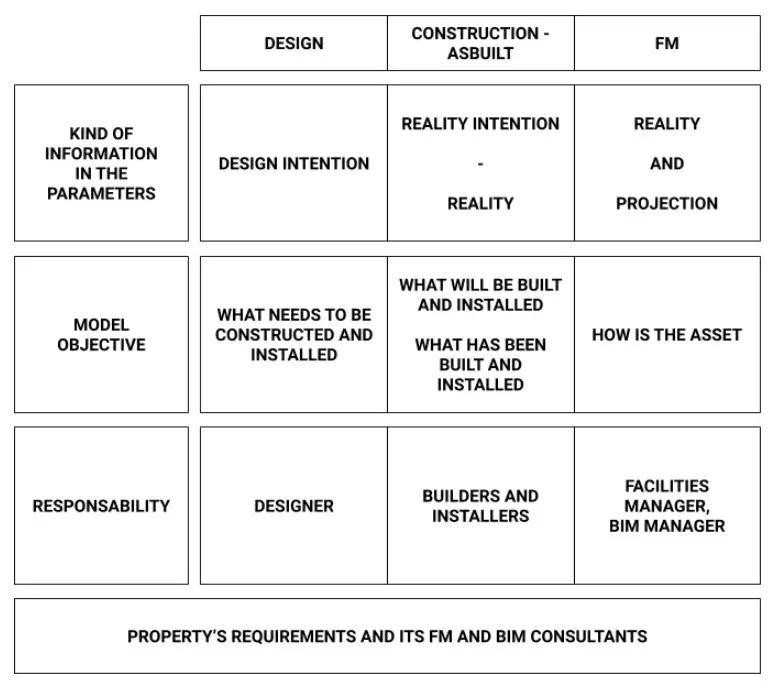
During the DESIGN phase, the parameters and their information are an INTENTION. The responsibility lies with the designer based on the performance required by the property and its own stamp and purpose. The purpose of the model is to document what is to be built and installed.
During the CONSTRUCTION and AS BUILT phase, the parameters and their information have two moments, the first one, where the builder modifies the model so that it reflects the way he is going to IMPLEMENT the design intention of the previous phase, and the second one where the model must reflect the REALITY of the end of the construction. The responsibility for the information lies with the builder and the subcontractors.
During the OPERATION and MAINTENANCE phase the parameters and their information must reflect the REALITY of the physical asset and also the PROJECTION of its behaviour. The model must reflect how the asset is, and the BIM managers should be the ones responsible for maintaining the models.
Throughout this process or cycle ( if we consider that part or all of the FM models can become the basis for the design of renovations or extensions) the optimum would be that at all times the OWNER would be the owner of the information requirements that control this evolution of the parameters through the EIRs and BEP documents. Moreover, the FM and BIM consultancy should be present to monitor the suitability of the project based on its future behaviour and the suitability of the models based on their use in all phases.
Moving from one phase to another should mean a review of the parameters and their information inherited from the previous phase. Everything not being part of the intention of the current phase of the models should be eliminated. This purge should be recorded in the BEP for approval and monitoring.
For example, parameters that a Design team has used to characterize drawings or views based on organizational needs are unnecessary when that model is being managed by another company. These parameters should be removed.
Another example: the parameters referring to information about formwork, concreting, construction phases typical of a construction model, are not necessary in a FM model and should also be eliminated. (This is different from the fact that this asbuilt model should be maintained for possible future reference).
Parameter formats
There is no precise standard for the format of the parameters. The EIRs and the BEP are the documents where you define which parameters in particular are to be introduced in the models and in which criteria they are to be followed in the naming terms. It is recommended that the parameters naming should always be neutral, without references to the property that requires them or to the companies that create them.
The parameter type is a very important issue to take into account as we will probably want to make mathematical formulations between them.
It is also necessary to have a clear format for the information to be entered. It is very important that there is consistency in the languages used and in the nomenclature standard (capital letters, camel case, dashes, dots,…), so that the models are not a fatal mishmash to handle.
Conclusion
BIM is the best tool today to carry out quality projects in all senses, however to get the maximum potential from it, order and collaboration are essential. The order defines how we should use it and collaboration defines that this order is effectively fulfilled and the project can flow minimizing problems and risks.
Authors: Almudena Gómez and Sarai Zaballa
Estando de acuerdo, me gustaría apuntar al hecho frecuente de suponer el modelo As-Built como si fuera el modelo de Obra al finalizar esta, y responsabilizar de dicho modelo a la contrata principal. Aunque podría ser que por contrato así fuera, la responsabilidad el modelo As-Built (como lo era de la documentación As-Built antes del BIM) es generalmente de la DF (Dirección Facultativa). Y un modelo As-Built, cuyo objetivo es constatar lo que hay construido, y no cómo se ha construido, es más parecido al modelo de Diseño que al modelo de Obra, pero en vez de reflejar intenciones refleja realidades, pero con el mismo o parecido nivel de granularidad. Por ejemplo, para su uso en obra, nos puede interesar dividir una losa para identificar los lotes de hormigonado, y añadir parámetros e información de fechas de ejecución, etc. Pero en el modelo As-Built, solo nos interesa la losa como elemento terminado completo, y todos los parámetros necesarios durante la obra ya no son relevantes. He leído que muy correctamente en otro post se ha hablado de esto mismo sobre el paso del modelo As-Built al modelo para FM, no pretendiendo que uno sirva para lo otro “tal cual”. Sólo quería incidir en esta idea, acertada, y señalar que en mi experiencia, el modelo de Obra nace y muere con la Obra (gestionado y explotado por el contratista principal), y es más el modelo de Diseño el que es actualizado y llevado a modelo As-Built por la DF, nutriéndose de los informes y actualizaciones emanados del modelo de Obra y que la Contrata debe ir proporcionando. Saludos
Hola Álvaro, muchas gracias por tu reflexión. Realmente la responsabilidad y autoría del modelo AsBuilt es algo que debería dejarse bien claro en el contrato de obra. A partir de ahí aplican los mismos comentarios del Post: ser muy conscientes del uso posterior de ese modelo y la pulcritud en los parámetros e información contenida. Dudo en si tener constancia de la planificación de la obra (por lo que comentas de los lotes de hormigonado) tendría valor a posteriori, aunque en todo caso también podría incluirse el modelo de Obra en sí en el archivo.
Muchas gracias de nuevo por tu comentario! Saludos, Almudena