

Why an As Built is not an FM model?
It is quite common to hear about models in the Design or Construction phase that are going to be used as a FM model later on. . However, many times the terms of use of that model for the FM are not well defined. For this reason, designers and builders go around blindly trying to comply with the vagueness of these requirements. In my opinion, even if those requirements exist (or precisely because of them), the As Built model is not automatically a model for FM. In the following text I will try to explain why.
Models according to Life Cycle phases
Before going into the question giving the title to this Post, it is convenient to put ourselves in context and talk about the differences of the BIM models along the project lifecycle. The figure below shows an outline.
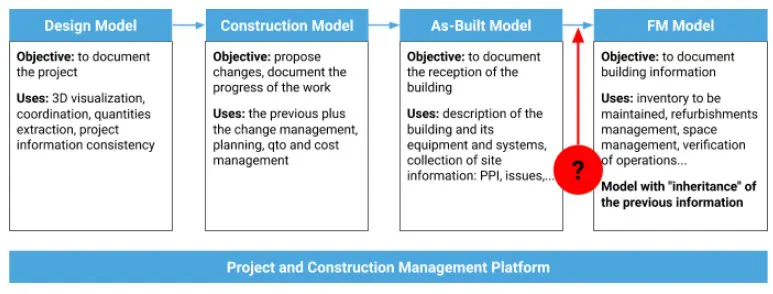
The Design Model aims at documenting the project, this means that it has to explain what has to be built. Typical uses of the BIM in this phase are 3D visualization, coordination between disciplines, consistency in the project information, …
A Construction Model has the objective of documenting the progress of the construction works and also the proposal for changes with respect to the Design Model. In this phase, the typical uses of the BIM would be all the previous ones plus construction works planning, changes management, QTO and cost management, …
Once the construction is finished we arrive at the moment of delivering the As-Built model. The As-Built documentation is a contractual documentation. Updated plans must be delivered according to the reality of the construction works. The objective is to document the reception of the building, the model must describe what has been built and also its equipment and systems.
In the Operation and Maintenance phase, the FM model must serve to document the information of the building. Its uses range from 3D navigation, to the repository of the inventory to be maintained, space management or verification of operations.
The post The parameters lifecycle in a BIM model
reflects a little more deeply on the changes in the information contained throughout this journey through the different phases.
It should be noted that not all the information is in the BIM models, but there should also be (in many projects it already does) what we have called a Project and Construction Management platform. Indeed, especially in construction, there is a multitude of other relevant information, referred to the construction works but which should not be in the model. We are talking about reports on inspections, change orders, material approvals,issues, operation manuals, user’s guides, start-up reports… In a digital scenario, all these issues can be managed by means of dedicated platforms.
BIM models for Facility Managementment
Is the As-Built model useful as a FM model?
This question must be answered on the basis of two questions:
Does the model contain all the information, in content and format, ready to be used in the FM phase?
Is the model suitable for the FM use I want to give it?
As for the first question, we may find, for example, that the naming criteria used in the Project and Construction phase may not be useful in the Operation and Maintenance phase, for example, finishes coding, budget codes, spaces names and codes,… all these classification systems which are correct in their own phases, may not be suitable for the building in operation.
It is also possible that in order to design a good Maintenance and Replacement Investment Plan, it is necessary to break down into different parts some equipment that in the Design and Construction phase are a single element, since maintenance actions and the useful life of these equipment must be discretized. For example, an elevator could be divided into an engine, a cabin, a guide system, etc., but it would be absurd to model it in this way in previous phases.
We will often find that the As Built model is made up of several models, not only with the typical division of disciplines (architecture, structures and mep) but also according to construction batches. This division for the operation phase would not have much sense now but perhaps it does make sense to separate them according to another criterion, for example, services providers.
It will be necessary for FM management to consider these changes. However, are FM managers capable of operating in BIM? One thing is model editing, which must be done by specialist profiles and another thing is to consume the models, which is what owners, users or facilities managers are going to do. To go deeply into this topic see this post: How is going to use BIM a Facility Manager?
And with this we link to the second question. It is about seeing if the model is suitable for its use as a FM tool.
First of all we must ask ourselves if there is a plan for that, that is to say, who is going to take advantage of it? In what way? From what applications? If those questions do not have an answer it will be of little use to have a BIM model.
A first example would be the integration of the models in a CMMS. This is basically, apart from a 3D viewer, the integration of the inventory. The first thing to do is to indicate in the model the elements that are going to be subject to maintenance. Is this something that could be done during the construction phase? Of course. But I haven’t yet found myself in the case that an FM is already assigned at that stage. Hopefully, the time will come when it is. In the meantime, it will be something to do in the future.
Siguiendo con el tema del inventario, para conseguir una integración real, posibilitando la bidireccionalidad de los datos, al modelo BIM seguramente habrá que añadirle nuevos parámetros en función de la estructura de datos del GMAO.
Continuing with the inventory issue, in order to achieve a real integration, making possible the bi-directionality of data, the BIM model will surely have to add new parameters depending on the data structure of the CMMS.
As far as performance factors are concerned, a model full of details, views and plans generated for the As-Built will be too heavy, all these elements do not need to be within the operation model (if you need to consult them you can use the As-Built), and it is convenient to remove them. The same happens with the modeling strategies themselves, sometimes the design and construction require complex, highly parameterized and detailed objects that in FM can be much simpler and take up less memory.
All of the above are approximations of what an FM model should look like, but each case will be special and an ad hoc solution will have to be found depending on the design of the FM management, the involved stakeholders, the existing models, etc.
FM model from something already built
And what happens when you try to make an FM model on a building that was built without BIM?
Then, contrary to what we could think, it will be easier since we are only going to model what is essential. Moreover, the model can grow as it is being really used and required by the FM Team, meaning that it is not necessary to do everything at first, you can add more geometry and information as more budget is assigned.
In these cases the problem usually comes from how to collect the information, especially in cases of buildings of a certain age that have undergone a high number of transformations over time. In this case study we show you a real project of this casuistry.
Conclusions
Models and their contained information must respond to the intention that governs each of the Building phases. In the case of the Operation and Maintenance phase, on one hand, much of the information generated in the Design and Works phase is superfluous, hindering the uses of the model, while on the other hand the information structure of the model may not be adequate for integration into FM management. This is why the models resulting from the delivery of construction works must go through a process of review and adaptation for use as a Facility Management tool.
Authors: Almudena Gómez and Alberto Ramos.