

Utilities: How to Prevent Information Loss During Asset Lifecycle.
Improving information quality for operations and maintenance in utility assets.
Utility companies manage their assets throughout their entire lifecycle, which means they are in charge of facility definition, construction, and the subsequent operations and maintenance. For this reason, it is crucial to ensure that the required information for each stage of asset lifecycle is transferred from the previous stage.
To achieve this, many companies in the sector have already adopted Building Information Modeling (BIM) as a fundamental tool to capture, manage, and utilize asset information from project inception through facility decommissioning.
However, though asset digitization provides broader and more accurate information, the loss or inadequate management of this data still results in significant operational inefficiencies.
For example, after completing the construction of facilities such as substations or power lines, asset information often continues to be manually recorded in Maintenance Management Systems (MMS). This process usually assumes data loss and opens the door to human errors. Later in the operational phase, repairs and inspections are planned using the information extracted from MMS, missing a reliable view of the physical reality of the installations. This lack of contextual information limits precise maintenance planning, causing delays and jeopardizing infrastructure service.
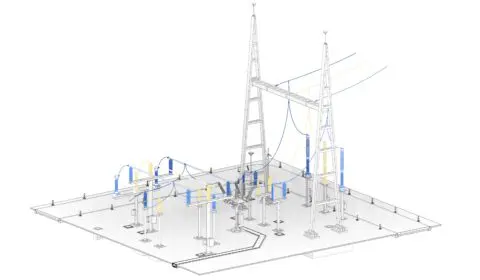
To avoid information loss and enhance information quality for the operations and maintenance of assets, we propose to leverage BIM and focus on these three key aspects:
Aspect 1: Improve efficiency in data transfer
In the utilities sector, engineering solutions are predominantly standardized, with facilities often having similar components. Over the years, it has allowed service companies to develop structured maintenance systems based on these standard configurations.
However, during project and construction stages, projects are often carried out without considering the standard data structure used in MMS. Additionally, the teams work with CAD and PDF drawings, which lack structured data and fail to reflect the three-dimensional reality of the project. As a consequence, when infrastructure is handed over to operations and maintenance, technicians must manually process this unstructured information from the previous phase. This manual data processing not only assumes information loss but also requires significant economic effort and dedication.
Aspect 1, Action to take: Implement asset data structure (typically used in maintenance) during project and construction stages.
To address this issue, the initial step involves developing projects and monitoring construction with a system that provides structured information. Using BIM models allows for structured asset information where project objects are categorized and contain detailed equipment data.
Moreover, in BIM models, it is possible to replicate the data structure used in maintenance, ensuring correspondence between the elements used in the project and in maintenance.
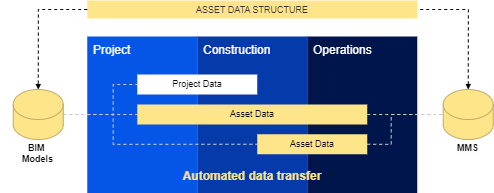
By structuring information according to a single data model (the maintenance model), it is possible to automate the transfer of information between lifecycle stages without human intervention.
Aspect 2: Preserve and leverage context information useful for operations and maintenance
During maintenance, multiple operations are conducted on installations. Some of these operations require prior planning, estimating necessary auxiliary means such as cranes, hydraulic jacks, and verifying equipment access conditions.
In such scenarios, having reliable information about the context in which equipment is installed—access to a precise digital model of installations integrating all their properties and those of the equipment—is crucial to reducing preparation and execution times for interventions.
The BIM model, resulting from design and construction phases, provides an accurate representation of installations and equipment in their existing conditions. This model allows anticipating the need to dismantle parts of the infrastructure, planning necessary clearances, and verifying the feasibility of bringing required machinery to the intervention site.
Aspect 2, Action to take: Utilize information contained in BIM models to access precise contextual information.
With structured information in the BIM model, we can link the model objects with the assets registered in the CMMS. This way, we can retrieve the geometric information of the assets from the CMMS. Similarly, we can access the information stored in the maintenance system through the objects contained in the model.
Thanks to this reliable contextual information, technical teams can accurately anticipate maintenance interventions, the need for auxiliary resources, spare parts, or special access conditions.
Aspect 3: Ensure necessary information at each stage of asset lifecycle and for each use case
During an asset’s lifecycle stage, information defined in a previous stage is often required.
For example, to ensure traceability of installed equipment, serial numbers are collected during installation, and these references allow them to be located during the maintenance stage. However, some construction-related information may not be useful during maintenance, such as planning activities during material installation. In the first case, the information generated during construction must be passed on to maintenance, while in the second case, the information should be discarded when the installation is transferred to maintenance.
It is important to establish the information needed at each stage of the asset lifecycle and the information that can be carried forward from the previous stage. For this, it is essential to have a clear understanding of the intended uses of the model at each stage.
Aspect 3, Action to take: Define use cases at each lifecycle stage and identify necessary information for each.
To ensure appropriate information availability, precise use cases must be defined. This entails specifying which information is to be extracted from BIM models at each stage and when this information is collected.
Once this exercise is completed, the structured and related information becomes easily accessible as outlined in the previous points. Any unnecessary information becomes noise and thus isn’t carried forward from the previous stage.
Conclusion:
To improve the quality of information in operations and maintenance, companies in the sector must integrate the BIM methodology from the design and construction phases. This methodology allows for structured information throughout the entire lifecycle of the assets and enables the systematization of the following actions:
- Align the data structure of the project BIM models with the data structure of the assets in the CMMS.
- Automate the information transfer processes.
- Connect the physical reality of the BIM models with the equipment in the CMMS.
- Define precise use cases to identify the information to be brought from the BIM models.
It is important to highlight that implementing the BIM methodology entails a change management process that requires effort and perseverance from the organizations. However, this change lays the foundation for a broader digital strategy that connects investments, ongoing projects, and the management of existing assets.